
Quick Answer: Seawater reverse osmosis (SWRO) desalination is quickly becoming the go-to, climate-proof way to get water for coastal areas hit by drought. Modern SWRO plants make water for just $0.50-$2.00 per cubic meter. They do this by using smart energy recovery, membranes that reject a lot of salt, and often, renewable energy. Globally, we’ve installed systems that produce over 100 million cubic meters of water daily, serving more than 300 million people. AMPAC USA builds SWRO systems, from small 1,000 GPD units to big industrial ones producing over 50,000 GPD.
We’ve been using up fresh water so fast for so long, our natural water sources around the world are running dry. This is a huge problem. Things are especially bad in tropical and offshore areas; they’re facing severe water shortages.
Of course, people are trying their best to cut down on water waste. But even with all these efforts, water levels keep dropping. Why? Because we can’t just stop using water. It’s essential. So, in this tricky situation, seawater desalination has stepped up as the most practical answer.
Seawater desalination simply means cleaning seawater to turn it into pure drinking water. This really helps solve the problem of dwindling water supplies while keeping water flowing for general use, especially for drinking.
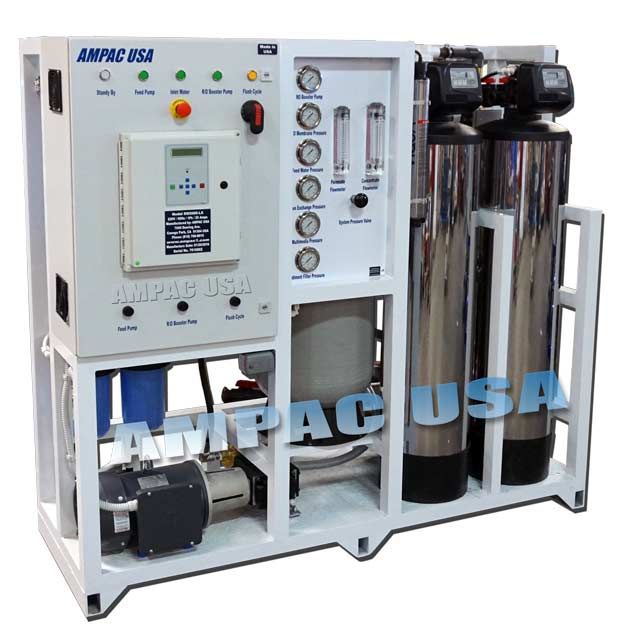
The process uses reverse osmosis. A seawater desalination reverse osmosis plant has a few treatment stages. First, there’s pre-treatment. This stage removes solid impurities and helps your reverse osmosis plant last a long time. Next, high-pressure pumps and membrane elements purify the water, taking out salts and chlorides. Finally, we have post-treatment, also called polishing steps. These steps condition the purified water from the reverse osmosis process. This three-step approach ensures that ocean and sea water becomes clean and safe to drink.
Frequently Asked Questions
How much does it cost to produce desalinated water?
Modern Seawater Reverse Osmosis (SWRO) plants produce water at a cost of $0.50 – $2.00 per cubic meter. This efficiency is achieved through advanced technologies like energy recovery devices, high-rejection membranes, and the integration of renewable energy sources, making it an increasingly economical option.
What is the process of seawater desalination using reverse osmosis?
Seawater desalination via reverse osmosis (SWRO) involves a three-step process. First, pre-treatment removes solid impurities to protect the system. Next, high-pressure pumps force water through specialized membranes, effectively removing salts and chlorides. Finally, post-treatment, or polishing, conditions the purified water to ensure it is safe and suitable for drinking and general use.
What types of seawater desalination systems does AMPAC USA manufacture?
AMPAC USA designs and manufactures a comprehensive range of Seawater Reverse Osmosis (SWRO) systems tailored for various applications. Our offerings span from compact 1,000 GPD (Gallons Per Day) units for smaller needs to robust industrial systems capable of producing over 50,000 GPD, serving commercial, industrial, and municipal clients.
How widely is seawater desalination used globally to address water shortages?
Seawater Reverse Osmosis (SWRO) desalination is a globally significant solution, with an installed capacity exceeding 100 million cubic meters per day. This extensive infrastructure currently supplies clean, potable water to over 300 million people worldwide, particularly in drought-affected coastal regions and offshore areas facing acute water scarcity.
Why is seawater reverse osmosis considered a reliable solution for drought conditions?
Seawater Reverse Osmosis (SWRO) is considered a reliable solution for drought because it provides a climate-independent water supply, drawing from the ocean’s inexhaustible source. This ensures a consistent supply of fresh water regardless of rainfall patterns, making it critical for coastal regions and offshore operations where natural freshwater reservoirs are depleted.
AMPAC USA engineers custom water purification systems for commercial, industrial, and emergency applications — from 500 GPD to multi-million GPD. Trusted by municipalities, military, and industry worldwide.