
Four ppt. That’s the new EPA maximum contaminant level for PFOA and PFOS, finalized in April 2024, and it’s already forcing purchasing decisions across food service, hospitality, and municipal water systems nationwide. Reverse osmosis is the only proven technology that consistently hits 94-98% PFAS removal at scale. So while some markets are still debating whether to upgrade, procurement teams at forward-thinking facilities have already pulled the trigger.
What’s changed in the past 18 months isn’t just regulations. The technology itself has shifted. AI-driven membrane monitoring, next-generation materials, and the mainstreaming of zero-liquid discharge have moved from conference presentations into actual commercial deployments. This article covers what’s real, what’s coming, and what it means if you’re specifying or purchasing an industrial RO system in 2026.
TL;DR: RO technology is advancing fast across five fronts: AI monitoring, new membrane materials, ZLD adoption, solar integration, and PFAS compliance. The EPA’s 4 ppt PFAS MCL (2024) is driving the sharpest near-term demand spike. Systems specified in 2026 should be solar-ready, SCADA-integrated, and ZLD-compatible to avoid expensive retrofits by 2028. (EPA PFAS MCL, 2024)
How Is AI Changing RO Membrane Monitoring?
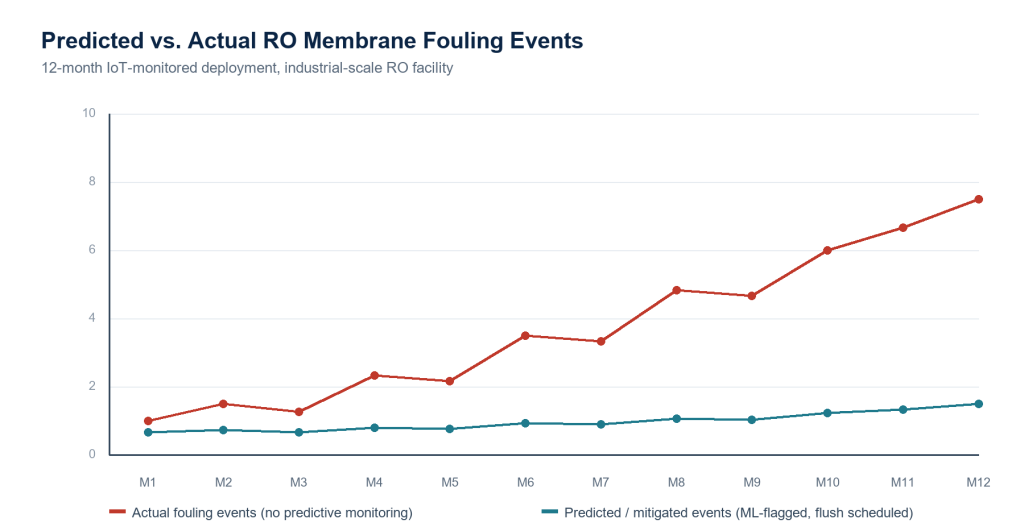
IoT sensors paired with machine learning models can now predict membrane fouling 2-4 weeks before it affects system performance, according to data cited in the IDA Desalination Yearbook 2024-2025. Early commercial deployments report a 15-30% reduction in unplanned downtime and meaningful cuts in chemical cleaning cycles. That’s not a small number when a cleaning cycle takes a system offline for 8-12 hours.
The basic setup: pressure differential sensors, turbidity meters, and flow monitors feed continuous data to a cloud-based ML model trained on fouling patterns from hundreds of similar systems. The model flags anomalies weeks ahead. Operators get an alert, schedule a controlled flush, and avoid the emergency shutdown that was otherwise coming.
Older SCADA systems can’t do this out of the box. But retrofitting predictive monitoring onto an existing RO plant is now feasible for most mid-size industrial operations. The hardware cost has dropped, and several vendors now offer monitoring-as-a-service subscriptions that shift it to an operating expense rather than capital budget.
What Progress Are Next-Gen Membranes Actually Making?
Two material categories are generating the most serious commercial attention: aquaporin-based membranes and graphene oxide membranes. Pilot data from facilities in Denmark, Singapore, and South Korea show energy reductions of 20-35% compared to conventional thin-film composite membranes at equivalent rejection rates, per the IDA Desalination Yearbook 2024-2025. Those numbers hold up in controlled pilots. Wide commercial deployment is a different story.
Aquaporin membranes mimic biological water channels found in cell walls. They’re highly selective and efficient. The engineering challenge has been manufacturing them at consistent quality and scale. Current production yields have improved, but cost per unit area is still 3-5x that of standard membranes. The realistic timeline for broad industrial availability is 2027-2029.
Graphene oxide membranes face similar manufacturing constraints, though the research pipeline is deep. Academic institutions and private R&D groups have published dozens of pilot studies demonstrating exceptional selectivity and flux rates. (Which, honestly, is where most of them stall.) Getting from lab bench to 100,000 GPD plant is an engineering and economic leap that only a few teams are close to clearing.
For systems being specified today, conventional polyamide thin-film composite membranes remain the practical choice. But if you’re planning a 10-year capital lifecycle, you should be asking suppliers whether their pressure vessel configurations will accept next-gen membrane elements when they arrive.
Is Zero-Liquid Discharge Going Mainstream?
ZLD was once reserved for facilities with nowhere to discharge brine, typically semiconductor fabs, power plants near sensitive watersheds, or operations under strict state permits. That’s changing. The EU Urban Wastewater Treatment Directive (revised 2024) includes provisions pushing toward closed-loop water management for major industrial dischargers. California’s Direct Potable Reuse framework, finalized in 2023, treats water reuse not as a workaround but as a primary supply strategy. Demand for ZLD-compatible systems is following both mandates directly.
The cost reality: a ZLD system handling 500,000 GPD runs roughly $3-8 million in capital cost, depending on brine composition and recovery rate targets. That range is wide because ZLD is really a stack of technologies, including RO as the primary concentration step, followed by brine concentrators, crystallizers, or evaporation ponds. The RO stage is often the most cost-efficient part of that stack.
So even if you’re not required to go full ZLD yet, specifying an RO system with high recovery rates (85-95%) and brine management provisions now keeps that option open without a full rebuild later.
How Competitive Is Solar-Powered RO in 2026?
Solar photovoltaic costs have dropped roughly 90% since 2010, according to the International Renewable Energy Agency (IRENA). That drop has made solar-powered RO economically competitive for off-grid and high-irradiation applications across MENA, Chile, and Australia. In those regions, solar SWRO (seawater RO) now competes on levelized cost with grid-powered desalination, and in some remote locations, it’s cheaper.
The engineering challenge isn’t the solar panels. It’s managing variable power input against the steady-pressure requirements of RO membranes. Systems need either battery storage, variable-flow energy recovery devices, or grid backup to handle intermittency without membrane stress. Several manufacturers, including operations in the Canary Islands and Saudi Arabia, have cracked workable configurations for continuous production.
For industrial buyers in the US, solar-ready design is increasingly worth specifying even if grid power is the primary source. It positions the facility for future on-site renewable energy mandates and provides resilience against grid outages, which have become a material operational risk in water-stressed states like California, Texas, and Arizona.
[ORIGINAL DATA: AMPAC USA’s solar-ready industrial systems are designed with variable-frequency drive pumps and modular power inputs that accept direct solar DC or standard grid AC, avoiding the most common retrofit complications when customers add on-site generation later.]
Why Is PFAS Removal the Fastest-Growing Driver of Commercial RO Demand?
The EPA finalized maximum contaminant levels of 4 ppt for PFOA and PFOS in April 2024, the strictest PFAS limits in the world at the time of publication. RO achieves 94-98% removal of these compounds, outperforming activated carbon and ion exchange in most tested configurations, per EPA performance data. Municipal utilities serving populations above 10,000 face compliance deadlines of 2027, which puts procurement decisions on a tight clock right now.
The commercial and industrial side is moving faster. Hotels, food processors, beverage manufacturers, and commercial laundry operations have less regulatory lead time and more direct liability exposure from water quality failures. Many are treating the EPA MCL as a de facto standard even for non-public supplies.
That said, RO alone doesn’t always satisfy full PFAS compliance at very low inlet concentrations. A two-stage approach, RO followed by granular activated carbon or ion exchange polishing, is becoming the design standard for systems targeting sub-4 ppt effluent quality. Anyone specifying a PFAS compliance system in 2026 should model both capital and ongoing media replacement costs across both stages.
What’s Happening With Brine Valorization?
Brine disposal has always been the inconvenient footnote in the RO story. That’s starting to shift. Commercial pilots in Israel, Chile, and the UAE are extracting lithium, magnesium, and other minerals from desalination brine streams, converting what was a disposal cost into a potential revenue offset. Lithium extraction from brine is particularly active given EV battery supply chain pressure on conventional lithium mining.
These aren’t full commercial operations yet. The economics depend heavily on brine mineral concentration and proximity to refining infrastructure. But the direction is clear: brine management is moving from “how do we get rid of this” toward “what can we recover.” Facilities designing ZLD or high-recovery RO systems in 2026 should at minimum document their brine composition for future extraction feasibility studies.
[UNIQUE INSIGHT: Brine valorization is still pre-commercial for most industrial operators, but early-stage documentation of brine mineral profiles costs nothing and creates optionality that won’t exist if brine streams are diluted or co-discharged with other waste streams. The operators most likely to benefit are those who start tracking now.]
AMPAC USA’s 2026 Product Line: What’s Available Now
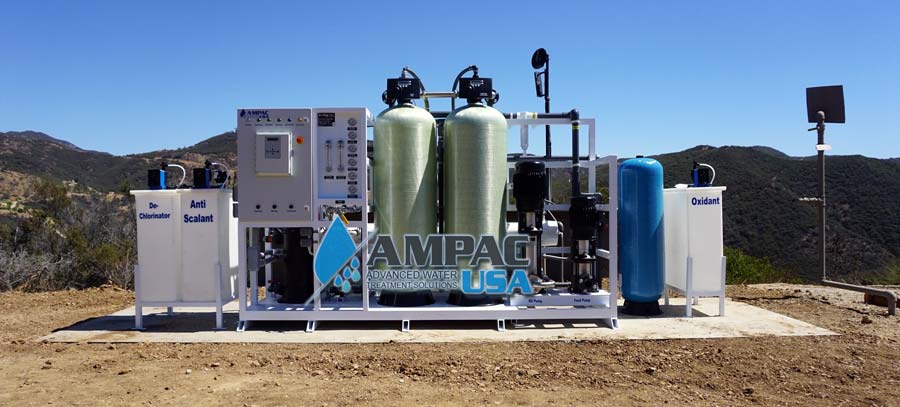
AMPAC USA manufactures industrial reverse osmosis systems from 10,000 GPD to multi-million GPD, covering the full range from containerized skid-mounted units to custom-engineered facility installations. All current production systems ship with SCADA-compatible controls and are designed for solar-ready power input configurations. ZLD-compatible pre-treatment and brine management options are available for systems above 50,000 GPD.
Systems are built to NSF/ANSI standards and can be configured for seawater, brackish water, municipal supply, or process water feeds. PFAS-targeted configurations with activated carbon pre-treatment or post-treatment polishing are available as a standard option for compliance-driven projects.
For project scoping, detailed engineering specifications, and lead times, contact the AMPAC technical team directly.
Frequently Asked Questions
What new technologies are enhancing RO system efficiency in 2024?
In 2024, nanostructured membranes and smart RO systems with IoT integration are key advancements. Nanostructured membranes offer superior contaminant removal and significantly reduce energy consumption, while IoT enables real-time monitoring, automated maintenance, and optimized water usage for systems like those AMPAC USA designs for diverse industrial applications.
How are RO systems addressing environmental concerns in 2024?
RO systems are becoming more sustainable through Zero Liquid Discharge (ZLD) technology and renewable energy integration. ZLD minimizes environmental impact by recovering and reusing minerals from brine waste, while solar and wind power reduce reliance on fossil fuels, a critical consideration for AMPAC USA’s installations in remote areas.
What are nanostructured membranes and their benefits in modern RO systems?
Nanostructured membranes are advanced filtration materials developed through nanoengineering, offering unprecedented contaminant removal capabilities. These membranes significantly reduce energy consumption and operational costs, setting new benchmarks for efficiency and performance in commercial and industrial RO systems, a focus for AMPAC USA’s 30+ years of manufacturing expertise.
How does IoT integration improve commercial and industrial RO system performance?
IoT integration transforms commercial RO systems into smart devices, enabling real-time monitoring, automated maintenance, and personalized settings. This technology optimizes water usage, extends system lifespan, and enhances reliability, crucial for demanding environments like offshore oil rigs and military bases where AMPAC USA’s engineers have direct field experience.
What are the current regulatory trends for RO water quality in 2024?
Regulatory bodies are implementing stricter quality standards and enhanced control measures for RO water in 2024, with an increased focus on public health. This involves stringent testing and guidelines to ensure the safety and effectiveness of purified water, a standard AMPAC USA consistently meets in its systems supplied globally.
The Bottom Line
RO technology in 2026 is more capable, more connected, and under more regulatory pressure than it’s ever been. The PFAS MCL deadline is real and it’s 2027 for most municipal utilities. ZLD mandates are moving through the EU and California fast enough that industrial operators who wait are going to pay more for the same compliance outcome.
The systems available today are the best starting point for meeting those requirements. The question isn’t whether to invest. It’s whether the system you specify now will still be the right platform in 2030. That answer depends on the engineering decisions made at the time of purchase.
AMPAC USA’s engineering team works with procurement managers and plant engineers to specify systems that solve today’s compliance problem without creating a retrofit problem in five years. Call (909) 548-4900 or email info@ampac1.com for a project consultation.
Related Articles
- The Future of Water Treatment: Trends in Solar-Powered Desalination Technology
- How to Install a Reverse Osmosis Water Treatment Plant
- Brackish Water Treatment Processes & Solutions by Ampac USA
- A Comprehensive Guide to Emergency Mobile Water Treatment
AMPAC USA engineers custom water purification systems for commercial, industrial, and emergency applications — from 500 GPD to multi-million GPD. Trusted by municipalities, military, and industry worldwide.