Quick Answer: The global water crisis affects approximately 2.2 billion people who lack safe drinking water and 3.5 billion who lack adequate sanitation. The burden falls most heavily on rural and peri-urban communities in low-income countries, women and girls, and communities in arid and semi-arid regions facing increasing climate stress.
Wherever you turn, you may have come across some news related to water crisis. It is either lack of it or contaminated water that has been haunting the lives of millions today, but it is there. Cape town was the first to go down when it came horrifyingly close to Day 0, a day when the city starts level 7 of water restrictions. The talks around Day Zero began in late 2017 for the city. At that time, the dams were only at 15-20% of their capacity threatening the lives of so many people. Subsequently in February 2018 and was able to bring down its usage by half to 500 million liters per day. That combined with the generous rains in June 2018 helped the dams to recuperate and refill to 70% of their capacity by September 2018. Post this, the restrictions were loosened a little and Day Zero was delayed. But for how long?
The Unlucky Ones
Cape Town is one of the many examples where despite generous rains, the city came close to potentially run out of water. But not every city or country is that lucky. A major part of Tanzania is in arid and semi-arid regions. 3 of the biggest lakes flank at the borders of the country leaving a large number of its people dependent on other sources, not necessarily hygienic. A lot of the underground water has drainage channels in the neighboring areas causing some of its chemicals to seep into it. It is not always clean and sanitary but nevertheless the only option for the people who have nothing to drink. Even turning to surface for some solace is a dangerous precedent as it is contaminated with the waste of washing clothes, utensils, and human feces. According to the Tanzania National Website, water-borne illnesses, such as malaria and cholera account for over half of the diseases affecting the population. The country has been in a war for the longest time for sanitation but to no avail, today the situation remains the same as it was in the 1970s.
The Ones Without
Ever since the news of Cape Town broke out, countries and organizations began evaluating the management systems on their own. And as it was feared, Cape Town was just the tip of the iceberg. 11 cities around the world are in danger of running out of water soon and more than 20 major global cities are already on high alert. Some of these include Sao Paulo whose main reservoir had only 4% of its capacity full in 2015. Even after efforts put in, by January the reservoir was only at 15% capacity. At the height of its crisis, the city had only 20 days of supply left.
Similar is the case with Bangalore, Beijing, Cairo, Jakarta, Istanbul, Mexico City, Tokyo, and Miami. In all these cities, either the available sources are contaminated or are not available at all due to lack of management systems, investments, and ongoing drought. The crisis is more worrying for Moscow and London. According to the Greater London Authority, the British capital is likely to have supply problems by 2025 and shortages by 2040. More than a quarter of the world’s available freshwater reserves are in Russia but the country is plagued by the pollution caused in Soviet Industrial era. The city of Moscow like the rest of the country is 70% dependent on the surface sources but the country accepts that 35-60% of its surface water is not safe for consumption or human usage.
Who Does It Affect?
Potentially? Everyone! The water troubles have just begun and everyone is potentially in the lines of fire. The ongoing climate change is not helping and a need for better management systems with conservation initiatives need to begin at the earliest. The situation is about to turn for the worst as the population increases. According to a UN-endorsed report, water demand will exceed the supply by 40% by 2030 thanks to the combined effects of human action, population growth and climate change. The troubles will come to your city the next if steps are not taken immediately. Some of these include
- Better management and investment systems for the available sources
- Installation of high-standard water treatment systems to purify the contaminated sources
- Strict standards for houses with rainwater harvesting systems
- Better water store equipment to fulfill the needs for future
- Conservation initiatives for replenishing aquifers, dams, lakes and other sources.
About The Author:
AMPAC USA is a leading water treatment systems manufacturing company striving for 30+ years to provide solutions to the water troubles across the world.
Related Articles
Conclusion
The global water crisis doesn’t hit everyone the same way. Rural communities, women and girls who often bear the burden of water collection, and people in arid regions facing worsening climate stress carry a disproportionate share of the 2.2 billion people currently without safe drinking water. Fixing this isn’t just a matter of building more infrastructure, it’s a matter of getting it to the places that have been overlooked the longest. We look at one specific example of supply strain in our post on the first declared US reservoir water shortage. Contact our team at info@ampac1.com or (909) 548-4900 to talk about water treatment solutions for communities facing supply challenges.
Who Bears the Burden of the Global Water Crisis
The global water crisis is not a problem of absolute water scarcity — the earth has abundant total water — but of distribution, treatment, infrastructure, and governance. Safe water is unequally distributed: 90% of people in high-income countries have access to safely managed drinking water, compared to less than 30% in many low-income countries. Within countries, urban populations have far higher access rates than rural communities, and the poorest households within cities often pay the highest unit prices for water — purchasing from informal vendors at $1-20 per cubic meter compared to $0.10-0.50 per cubic meter for piped utility connections.
The health consequences of unsafe water are severe and measurable. WHO estimates that 1.7 million children under five die annually from diarrheal diseases, most attributable to inadequate water, sanitation, and hygiene (WASH). Waterborne diseases including cholera, typhoid, hepatitis A, and diarrheal illness caused by E. coli and rotavirus collectively account for an enormous burden of illness in low-income settings. Beyond mortality, water-related illness causes stunting, missed school days, reduced adult economic productivity, and cycles of poverty that compound across generations.
The economic dimension of the water crisis is often underappreciated. The World Bank estimates that water insecurity costs affected countries up to 6% of GDP annually through health costs, agricultural losses, and reduced labor productivity. Investment in water infrastructure has among the highest documented rates of economic return of any development intervention — WHO estimates a $4 return for every $1 invested in water and sanitation. AMPAC USA participates in global water access initiatives through appropriate-technology solutions for developing community water systems at scales and with operational simplicity appropriate for resource-limited settings.
Frequently Asked Questions
How many people worldwide lack access to safe drinking water and sanitation?
The global water crisis currently impacts approximately 2.2 billion people who lack access to safe drinking water. Additionally, a staggering 3.5 billion individuals worldwide do not have adequate sanitation facilities, leading to widespread health and environmental challenges. These figures highlight the immense scale of the ongoing crisis, particularly in low-income regions.
What specific challenges do communities in arid regions like Tanzania face regarding water access?
Communities in arid and semi-arid regions, such as large parts of Tanzania, face severe challenges including dependence on unhygienic water sources. Underground water can be contaminated by chemical seepage from drainage channels, while surface water is often polluted with waste from washing and human feces. This widespread contamination contributes to high rates of water-borne illnesses like malaria and cholera, which account for over half of the diseases affecting the population.
What was the ‘Day Zero’ crisis in Cape Town, and how was it averted?
Cape Town’s ‘Day Zero’ was a projected date in 2018 when the city’s water supply would be critically low, leading to severe Level 7 water restrictions. With dams at only 15-20% capacity, the city implemented drastic measures, successfully reducing water usage by half to 500 million liters per day. This combined with generous rains in June 2018 allowed dam levels to recuperate to 70% by September, delaying the crisis.
Beyond scarcity, what are the major health risks associated with unsafe water sources?
Unsafe water sources pose significant health risks, primarily through the transmission of water-borne illnesses. Contaminated water, often laden with human and animal waste, can cause diseases such as cholera, typhoid, dysentery, and giardiasis. In regions like Tanzania, these illnesses account for over half of all diseases, severely impacting public health and economic stability.
How can advanced water purification technologies help mitigate the global water crisis?
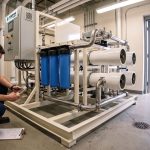
Advanced water purification technologies, such as industrial reverse osmosis (RO) systems, are crucial for transforming contaminated or brackish water into safe, potable resources. These systems, like those designed by AMPAC USA, effectively remove dissolved solids, pathogens, and chemicals, providing reliable access to clean water for municipalities, industries, and remote communities. Deploying robust, field-proven solutions is essential for building resilient water infrastructure and addressing both scarcity and contamination.
Need a Water Treatment Solution?AMPAC USA engineers custom water purification systems for commercial, industrial, and emergency applications — from 500 GPD to multi-million GPD. Trusted by municipalities, military, and industry worldwide.