

Home Products Industries Applications Solutions Support Insights Contact Us
Back to Blog
Nov 13, 2021·8 min read
Top-Benefits-of-Hiring-a-Property-Management-Company-in-California-1

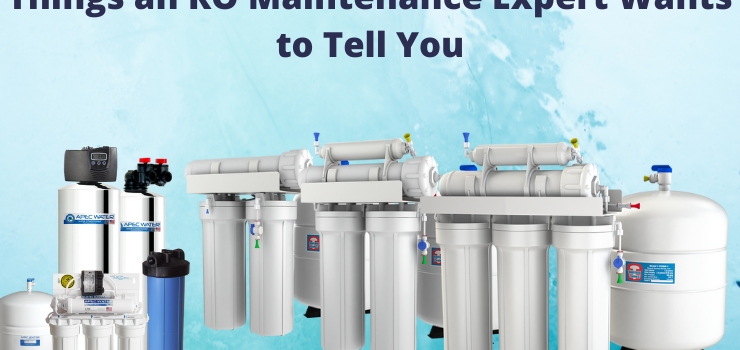
Things an RO Maintenance Expert Wants to Tell You

Quick Answer: Proper RO maintenance requires: replacing sediment and carbon pre-filters every 6-12 months, replacing the RO membrane every 2-5 years (monitor TDS rejection), replacing the post-carbon filter annually, sanitizing the system and tank annually, checking tank pressure annually, and testing product water quality with a TDS meter monthly.

When you want to drink pure water without any contaminants, you obviously have to rely on a water treatment system like a reverse osmosis system that will make the water pure and contamination-free. If you already own such a system or plan to own one for residential, commercial, or industrial uses, you should read on. Here are a few things an RO maintenance expert wants to tell you that will help you ensure that the water treatment system works fine and consistently gives perfect results. 

  • You Must Change RO Filters Regularly

One of the basic maintenance requirements of an RO system is the need to change the filters. An RO system will usually have multiple filters, and each of them would have a specific lifespan. The lifespan can vary from a few months to several years. You would be wise to talk about it with the manufacturer at the time of purchase. If you skip the step of changing RO filters, the system performance might be impacted, and water quality might be compromised. Even the production quantity can reduce, and the system might stop working completely after a while. 

  • Get Professional Cleaning Done 

When it comes to cleaning an RO system, many people follow the DIY approach and do the maintenance themselves to save time, effort, and money. If you are the same, you must consider getting the system cleaned by professionals thoroughly at least once a year. It will ensure that every part of the system is cleaned from inside out, and the system performs better in the long run. The money spent on professional cleaning is worth it in the long term. 

  • You Must Use a Water Softener

If the supply of water in your area is impacted and the water has higher levels of magnesium and calcium, it might impact the performance of your RO filters, and they might go bad soon. A smart solution in such a scenario would be to invest in a water softener that works in conjunction with the RO system to make water pure and contaminant-free. 

  • You Need to Clean the Exteriors

Many people are so focused on keeping the interiors of the RO system clean that they forget to keep the exteriors clean. You should not make the same mistake. You should ensure that you clean the exterior of the RO system by using a dry cloth or a wet cloth to get rid of the dust. You can also choose to keep the water treatment system covered with a cloth. 

  • Better Maintenance = More Lifespan

You should know that the better you maintain the RO system, the higher would be its total life. The system can last up to 10-15 years if you follow all the maintenance guidelines. The more it lasts, the more value-for-money deal it would be. 

  • Buy it from the Best- AMPAC USA

Experts also recommend that you buy the RO system from a top manufacturer like AMPAC USA to ensure that you get a maintenance manual with each product and top-notch quality customer service that helps you to keep the RO system in top shape. AMPAC USA’s water treatment systems are available for residential, commercial, and industrial use. They help ensure the water is tasteless, colorless, and odorless. 

AMPAC USA water systems are well equipped and fully capable of converting any water into a product that meets the requirement of the end-user. Capable of performing flawlessly in harsh environments, our products assist the exploratory labs at the Arctic Circle to Oil rigs in Deserts, urban communities, and war zones. AMPAC USA water treatment systems are proven solutions to water treatment problems across the globe.

AMPAC USA advanced water purification systems are built to solve the most complex challenges related to water purification, treatment, provisioning, and Seawater Desalination, meant to work in the harshest environments around the globe. Our water treatment systems use the best Reverse Osmosis, Seawater Desalination, and water technologies of International standards for industrial, On-shore, and Offshore applications.

AMPAC USA designs and manufactures some of the world’s most reliable Commercial Reverse Osmosis Water Treatment Systems to treat water even in the toughest environments. We additionally strive for quality of international standards and excellent after-sales service. Our engineers are available to provide support with your water treatment applications anywhere around the world. To know more, call us on 909-548-4900 or visit us here

References:

https://www.mrright.in/ideas/appliances/small-appliances/ro/best-tips-and-ways-to-maintain-an-ro-system/

http://blog.watertech.com/how-to-maintain-a-reverse-osmosis-system/

Related Articles

Conclusion

Most RO problems we get called out for aren’t equipment failures — they’re maintenance that got pushed back one too many times. Pre-filters are cheap and easy to swap, so there’s rarely a good excuse for letting a spent one damage a membrane that costs a lot more to replace. Pairing your system with a water softener in hard-water areas extends membrane life even further, which is the kind of detail that pays for itself over the years. For the full replacement schedule, see our reverse osmosis maintenance guide. Contact our team at info@ampac1.com or (909) 548-4900 to talk about a maintenance plan for your system.

RO System Maintenance: What Experts Do to Maximize Performance and Life

Reverse osmosis systems require regular maintenance to deliver consistent water quality and achieve their designed service life. Neglecting maintenance is the most common cause of gradual RO performance decline that many users attribute to system aging but which is actually preventable through simple scheduled care. A well-maintained RO system should produce water quality consistent with its first month of operation for 10-15+ years. The maintenance program centers on three areas: filter media replacement, membrane monitoring and care, and system sanitization.

Pre-filter replacement is the highest-priority maintenance item because exhausted pre-filters allow contaminants to reach and damage the RO membrane — the most expensive single component. Sediment filters (Stage 1) should be replaced when pressure differential across the housing exceeds 10-15 PSI or every 6 months in normal residential use with municipal water. Carbon block pre-filters (Stages 2-3) should be replaced every 6-12 months to ensure adequate chlorine removal before the membrane — a carbon filter that has exhausted its chlorine removal capacity while still passing water can allow chlorine to reach and irreversibly damage the polyamide membrane. The consequence of deferring carbon filter replacement is not just poor taste but membrane damage that requires expensive replacement.

The RO membrane requires performance monitoring rather than fixed-schedule replacement. Use a TDS meter to measure feed water TDS and permeate TDS monthly. Calculate percent rejection: [(feed TDS – permeate TDS) / feed TDS] x 100. New membranes achieve 96-99% rejection; replacement is warranted when rejection falls below 85-90%. Other indicators include: reduced flow rate despite clean pre-filters (membrane fouling), increased concentrate/permeate ratio, or unusual taste returning to product water. Annual system sanitization using an appropriate food-grade sanitizer flush prevents biofilm formation in the storage tank, tubing, and faucet lines. AMPAC USA provides detailed maintenance guides and replacement filter kits for all system models.

Frequently Asked Questions

How often should RO filters be replaced?

Sediment and carbon pre-filters should be replaced every 6-12 months to protect the RO membrane from particulates and chlorine. The post-carbon filter typically requires annual replacement for taste and odor improvement. Regular replacement ensures optimal system performance and water quality.

How frequently should an RO membrane be replaced?

An RO membrane generally needs replacement every 2-5 years, depending on water quality and usage. It’s crucial to monitor TDS rejection monthly with a TDS meter; a significant drop indicates the membrane is failing and needs immediate replacement to maintain water purity.

Is professional cleaning necessary for an RO system?

Yes, getting your RO system professionally cleaned thoroughly at least once a year is highly recommended. This ensures every internal component is sanitized and inspected, preventing biofilm buildup and extending the system’s lifespan, ultimately guaranteeing consistent performance.

Why should I use a water softener with my reverse osmosis system?

If your supply water has high levels of magnesium and calcium (hard water), a water softener is essential to protect your RO system. Hardness minerals can rapidly foul pre-filters and scale the RO membrane, drastically reducing its efficiency and lifespan. A softener pre-treats the water, preserving your RO system’s performance.

How often should I test my RO product water quality?

You should test your RO product water quality with a TDS meter monthly. This simple check helps monitor the efficiency of your RO membrane and overall system performance. A rising TDS level indicates potential issues, such as a failing membrane or inadequate pre-filtration, requiring attention.

Scroll to Top